Hedgerows, thickets and warblers.
How well do you know your warblers ??

From a farming perspective hedgerows are far more important than just boundary markers. They protect crops by acting as a wind break and provide shelter and shade for livestock. They also support diverse insect pollinators which are essential for pollination and yield. They also help to prevent flooding and soil erosion as well as being important for carbon storage.
A well maintained established hedge particularly with good field margins supports a huge range of biodiversity from small invertebrates all the way up the food chain to top predators. Hedgerows along with thickets are essential for the survival of some of our resident birds providing nesting sites, food, shelter from the elements and protection from predators.


Our hedges come alive in April as at this time resident birds are joined by Summer visitors, the vast majority of which have travelled north from sub-Saharan Africa. They come to our shores to breed. A large number of these additional species are warblers. Most of them have subtle colours unlike their bright American counterparts so some experience is required for their correct identification. They all have their own jizz and habits. Also they all sing well which can give you an immediate identification, so useful if they are hidden in thick hedge foliage and not on show. For the novice it is always worth having a listen to some recorded warbler songs before going in to the field. Nowadays many people use the Merlin ID app This is a free app developed by the Cornell Lab of Ornithology. It uses sound ID to recognise bird song species in real time, a great learning tool. The six species of warbler most likely to be encountered in this habitat are described and illustrated here.


The Chiffchaff (Phylloscopus collybita) and the Willow Warbler (Phylloscopus trochilus) are from then same family group of warblers and very similar in appearance however their songs are so different. The Willow Warbler has a beautiful descending soft whistling song, the Chiffchaff has a much simpler two note song and is one of the most familiar sounds in the countryside during the Spring and Summer months. During the Spring the Willow Warbler has a brighter more yellow/green plumage than the Chiffchaff and unlike the Chiffchaff does not have dark legs. Also the Chiffchaff has a habit of dipping it’s tail downwards, an action not seen in Willow Warblers.


The Blackcap (Sylvia atricapilla) and the Garden Warbler (Sylvia borin) are two of our greatest song birds, they can be thrush like and with flutey notes. It take practice to distinguish them especially if not in full song. When singing the Garden Warbler is often more concealed than the Blackcap and can take some spotting!
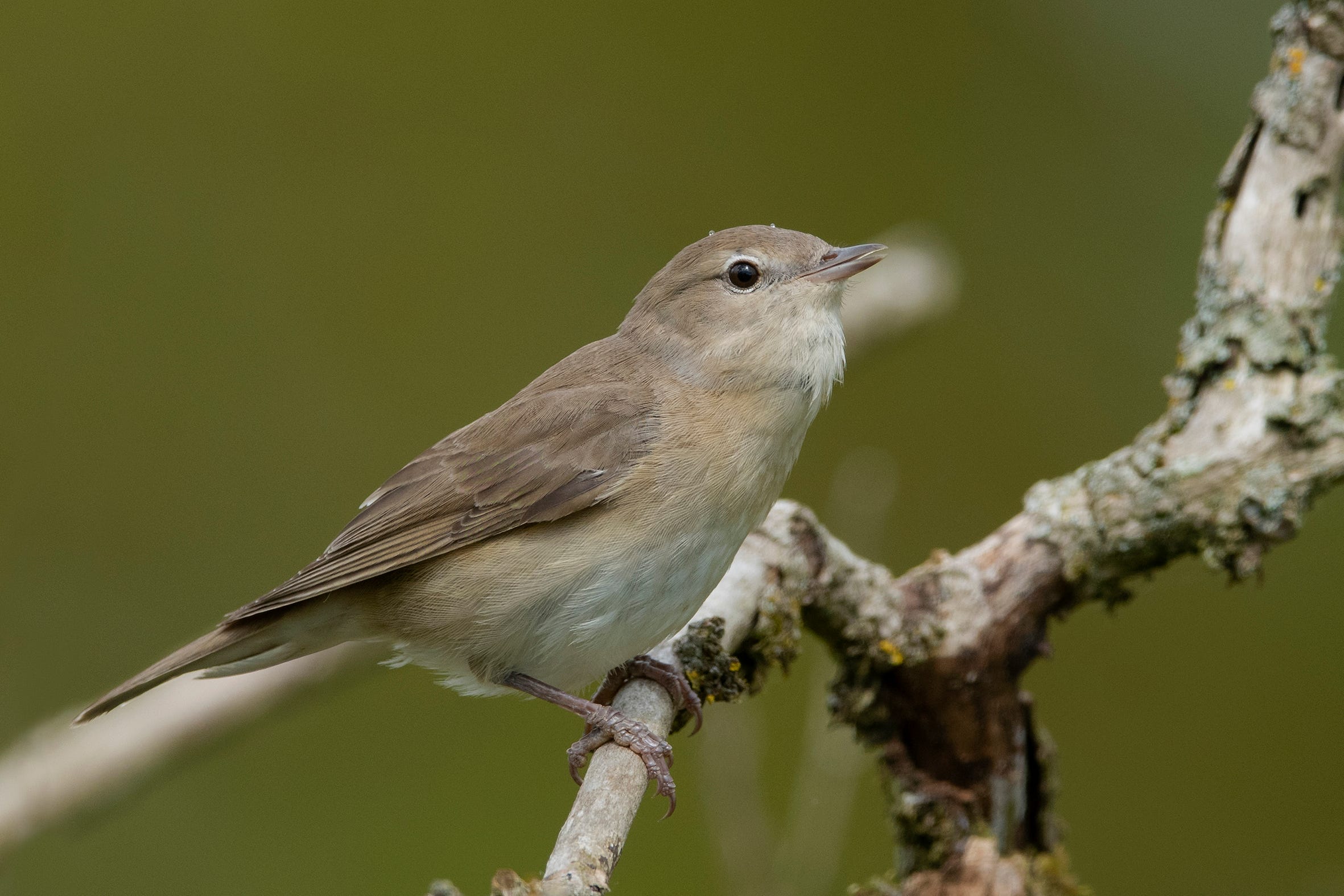
The Garden Warbler arrives a little later than the Blackcap. Some Blackcaps (and Chiffchaffs) now overwinter in the UK so these individuals may start singing a couple of weeks before Garden Warblers arrive. The Garden Warbler is a subtle mix of grey and brown, it’s stubby bill giving it a “kind” facial expression. The Blackcap is more grey and the male has a very obvious black cap. The female’s cap is chestnut.
The last comparative pair are the Whitethroat (Curruca communis) and the Lesser Whitethroat (Curruca curruca). The Lesser Whitethroat arrives a little later than than it’s cousin. Again they have their own distinctive songs but are not in the league of the Blackcap and Garden Warbler. The Whitethroat has a jerky scratchy song singing from an obvious perch but also in display flight. The song of the Lesser Whitethroat is completely different, a real rattle.


This bird will sing from dense cover as well at times (if you are lucky!) perched up. From a bird-watching perspective the Lesser Whitethroat has the frustrating habit of giving a burst of song and then just when you think you about get a view it has moved fifty yards further along the hedge! Of course both these birds have white throats but the Whitethroat is more warmly coloured and with a longer bill than the Lesser Whitethroat. Unlike the Lesser Whitethroat the Whitethroat (both male and female) have chestnut in their wings. The Lesser Whitethroat is a much greyer looking bird with sometimes quite a pronounced black mask. It is subtly beautiful and is my favourite of the six species described in this article but also the least common in the UK.
Richard Tyler - Gloucestershire
richardtyler.zenfolio.com
Lovely straightforward comparative descriptions Richard. Perfect timing as I am on the Ridegway near Marlborough tomorrow, and know we have both whitethroats , and I always find the garden warblers hard to ID. Thankyou